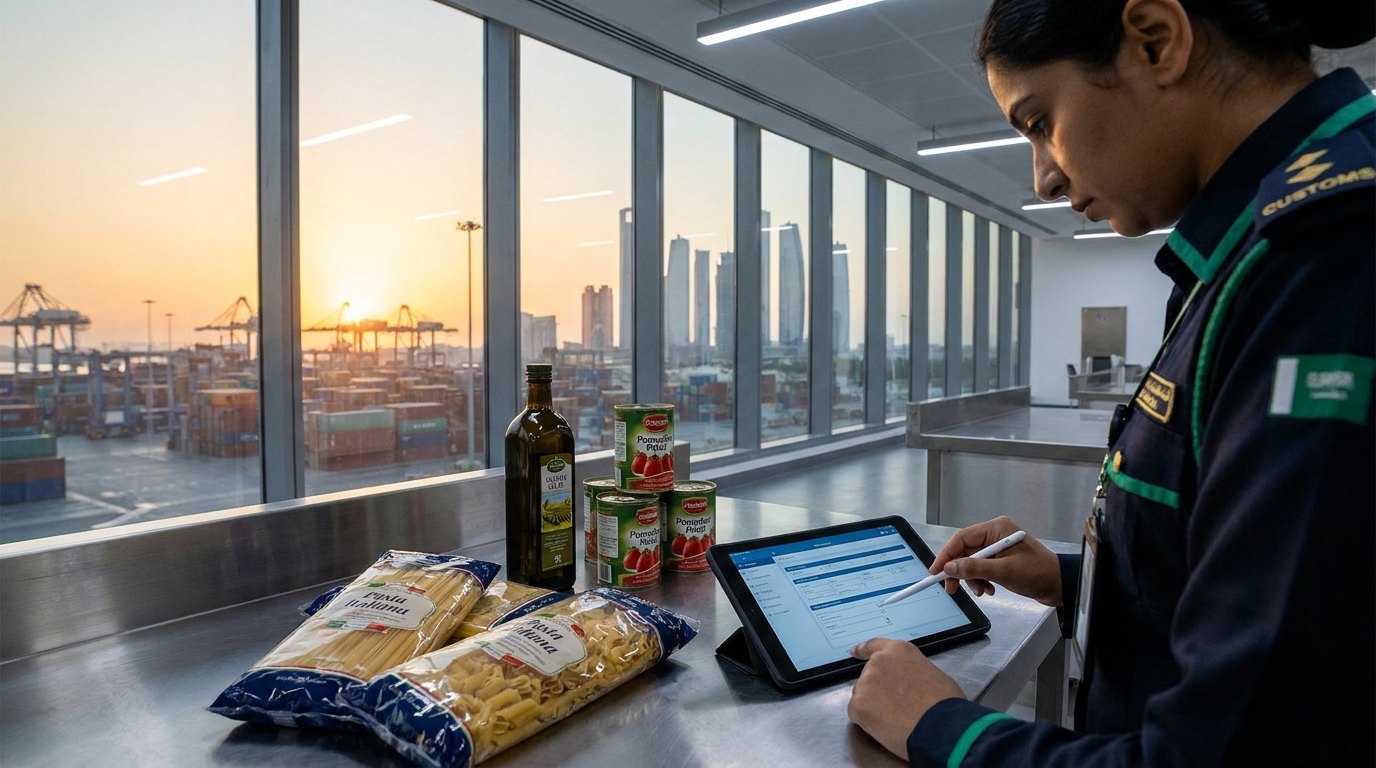
Abu Dhabi has launched the first operational use of an artificial intelligence system developed with OpenAI for managing food import checks. For an Italian company exporting to the United Arab Emirates, this change is not merely technological: it has direct implications for Halal documentation and customs clearance times.
In November 2026, Abu Dhabi brought into operation the first artificial intelligence system developed with OpenAI to manage food import checks. The platform is called Machine-Readable Government and, as reported by The Halal Times, human officials remain responsible for final decisions, but the system automatically reads and interprets the documentation submitted by exporters upon entry into the country.
This is not a pilot project: it is already live. And Abu Dhabi is one of the principal commercial gateways of the United Arab Emirates, a market that HQC Italia has monitored for years through its GAC and EIAC recognitions, which are valid across the entire Gulf region.
When an automated system reads customs documentation, the formal quality of the documents submitted becomes a critical factor. A Halal certificate issued by a body not recognised by the UAE authorities, an ambiguous description, an expiry date that does not conform to the required format, or a product code that does not match the one on the label can trigger an automatic hold before any official has even reviewed the file.
For an Italian food and beverage company shipping pasta, olive oil, cheeses, preserves, or any other product to the UAE, this means that Halal certification must not only be substantively valid but also readable and verifiable in an automated, digital manner.
Even though the full technical details of the platform are not yet public, automated customs document-reading systems typically operate on several key variables:
Before automation, a documentary error could be flagged to an official who would assess the situation on a case-by-case basis. With an automated system, a file can be held or flagged as non-compliant within seconds. The cost to a company is immediate: goods detained, storage charges, risk of deterioration for fresh or short shelf-life products, and possible return of the consignment.
This is not a hypothetical scenario. Even today, the UAE authorities apply stringent controls to food imports. Automation accelerates and standardises this process, reducing tolerance for formal inaccuracies.
The practical response operates on three levels.
1. Verify that your Halal certificate is issued by a body recognised in the UAE. Not all Halal certificates are equivalent in terms of international recognition. HQC Italia is recognised by GAC and EIAC, the reference authorities for the UAE and the Gulf region. A certificate issued by a body not included on the official UAE lists will not pass the checks, whether automated or otherwise.
2. Ensure documentary consistency with rigour. The product name on the certificate must correspond exactly to that on the label and in the commercial invoice. Any variation in format, any non-standardised abbreviation, any discrepancy between documents is a potential hold point for an automated system.
3. Begin or renew certification well ahead of shipments. The time required to obtain a Halal certificate varies depending on the complexity of the product and the number of ingredients to be verified. Planning with adequate lead time avoids a situation where a certificate has expired or is in the process of renewal at the moment the consignment is ready to depart.
The Halal certification process with HQC Italia involves the assessment of the product's technical documentation, verification of ingredients and suppliers, inspection of the production facility, and issuance of the certificate. HQC is accredited to ISO/IEC 17065 and recognised in over 50 Islamic countries, including the United Arab Emirates through GAC and EIAC. A quotation is free of charge and is provided within 24 hours of the request.
The automation of customs checks in Abu Dhabi is a clear signal: Gulf markets are raising the level of precision required. For an Italian company, Halal certification is no longer simply a document to be attached to a shipment. It is an element of the export supply chain that must be managed with the same attention given to product quality.
Source: The Halal Times – Abu Dhabi Food Import Checks Are First Live Use of OpenAI System
Tell us about your product and your target markets: the quote is free and arrives within 24 hours.