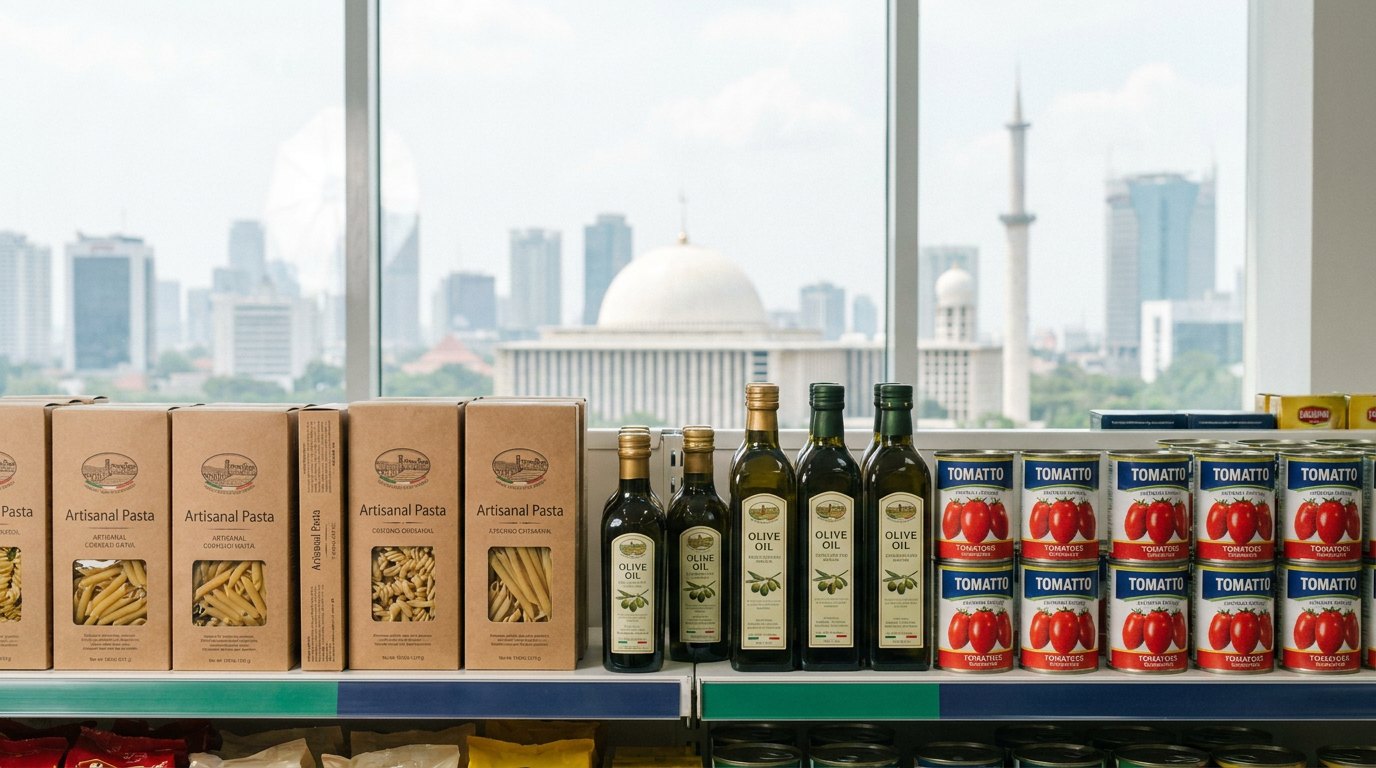
The Indonesian government has extended to 2028 the deadline for mandatory Halal certification for certain categories of products and services, through Government Regulation PP No. 42/2024. For an Italian agri-food company, this does not mean it can wait: it means having time to prepare properly and get there before the competition.
On 16 October 2026 the Indonesian government announced a partial extension of the deadlines for mandatory Halal certification. Under Articles 160 and 161 of Government Regulation (PP) No. 42/2024, certain categories of products and services — which should have complied by October 2026 — will now have until October 2028. The Indonesian body LPPOM immediately made clear that the extension is not a sign of slowing down, but an explicit invitation to prepare now.
It is worth recalling the context: Indonesia has around 280 million inhabitants, is the country with the largest Muslim population in the world and has for years been progressively extending the Halal requirement to all sectors of the economy. The October 2026 deadline had already covered key sectors such as imported beef. The extension to 2028 concerns additional categories, the details of which are set out in the regulation.
When a government grants an extension, less prepared companies tend to read it as an invitation to put things off. That is exactly the mistake to avoid. The Indonesian extension is meant to give local SMEs breathing space, not to reopen the window for foreign suppliers who should already have moved.
For an Italian agri-food company that intends to export to Indonesia, the reasoning is the other way round: those who get certified today reach the market ahead of competitors — European and otherwise — who will wait until 2027 or 2028. Indonesian retailers, local buyers and importers select foreign suppliers months or years before products actually reach the shelves.
Regulation PP No. 42/2024 is the legislative instrument that redefines the deadlines for the Halal requirement in Indonesia. The categories covered by the new October 2028 deadline include various products and services for which implementation is considered more complex. Italian companies intending to export should carefully check which category their products fall into, since some earlier deadlines — such as the one for imported beef, which came into force in October 2026 — remain unchanged.
In practice: if you export meat, there is no extension. If you export processed products, ingredients, cosmetics or pharmaceuticals, the deadline may have moved to 2028, but this does not mean the certificate is not already needed today to access organised retail and distribution.
The numbers help to show what is at stake. According to data presented at the Indonesia Sharia Economic Festival (ISEF) 2026, Indonesia's Halal supply chain grew by 5.5% year on year in the second quarter of 2026. The State of the Global Islamic Economy 2025/26 report ranks Indonesia fourth in the world for its overall Islamic economy, with leading positions in modest fashion, pharmaceuticals and cosmetics.
For an Italian agri-food company, this means looking not at a niche market, but at one of the most dynamic and structured Halal markets in the world, with an expanding middle class and growing demand for quality food products, including imported ones.
The extension to 2028 does not reduce the urgency: it shifts it. Companies that use this time to get certified, build relationships with local distributors and consolidate their presence on the Indonesian market will have a structural advantage over those who arrive at the last minute. HQC Italia, recognised by BPJPH for the food, cosmetics and pharmaceutical sectors, offers Italian companies a free quote within 24 hours.
Source: Halal Times – Indonesia Delays Mandatory Halal Certification to 2028, LPPOM Urges Businesses to Prepare Now (20 October 2026).
Tell us about your product and target markets: the quote is free and you will receive it within 24 hours.