Kuala Lumpur no longer wants to be merely a certifying country: the Malaysian government is calling on the Halal industry to become competitive in international markets. For an Italian food and beverage company, this shift in perspective has a direct consequence — those without a certification recognised by JAKIM risk being shut out of one of the most dynamic markets in the world.
In November 2026 the Malaysian government sent a clear message to the national Halal industry: being certified is no longer enough — you must export. Minister Zulkifli, speaking on the subject, stated that Malaysia must pursue international commercialisation and global competitiveness, moving beyond the logic of mere certification compliance.
This strategic shift does not concern only Malaysian companies. It concerns anyone who wishes to sell in Malaysia or use that market as a gateway to Islamic South-East Asia. If Malaysia raises the bar in terms of quality, traceability and international standards, the expectations placed on foreign suppliers rise accordingly.
Malaysia is one of the world's leading Halal reference markets. Its certification body, JAKIM, is one of the most widely recognised organisations in the international Halal ecosystem. Holding a certificate issued by a body recognised by JAKIM is equivalent to opening a door whose value extends well beyond Malaysia's borders: many countries in South-East Asia and the Gulf look to JAKIM recognition as a benchmark of reliability.
HQC Italia is recognised by JAKIM for Malaysia, as well as by MUIS for Singapore, CICOT for Thailand, MUI and BPJPH for Indonesia, SASO and SFDA for Saudi Arabia, and GAC and EIAC for the United Arab Emirates and the Gulf. This means that a certificate issued by HQC carries operational value in all these markets, without the need to multiply certifications.
Alongside the push for exports, Malaysia is introducing new rules on the traceability of Halal chicken. The proposals under discussion would allow consumers to verify directly the certification status and origin of chicken sold on the market. This is a clear signal: Malaysia is moving towards stricter supply-chain transparency, with control systems that will start at the producer level and reach all the way to the shelf.
For an Italian company exporting poultry or other food products to Malaysia, this means that supply-chain documentation — from ingredient to finished product — will need to be impeccable. Having a certificate will not be sufficient: it will be necessary to demonstrate that every stage of production is traced and verifiable.
The Malaysian minister's declaration contains a useful indication for those looking at the market from outside: global competitiveness in the Halal sector is built first and foremost on the credibility of standards. An Italian product entering Malaysia with a certificate issued by a body not recognised by JAKIM cannot be marketed as Halal in the country. This is not a matter of preference — it is a regulatory requirement.
This point is often underestimated by companies approaching the Islamic market for the first time. The Halal logo on a package does not carry universal value: what matters is who issued it and whether that body is accredited in the destination countries. Malaysia, with its drive towards higher standards and greater international competitiveness, is making this distinction even more evident.
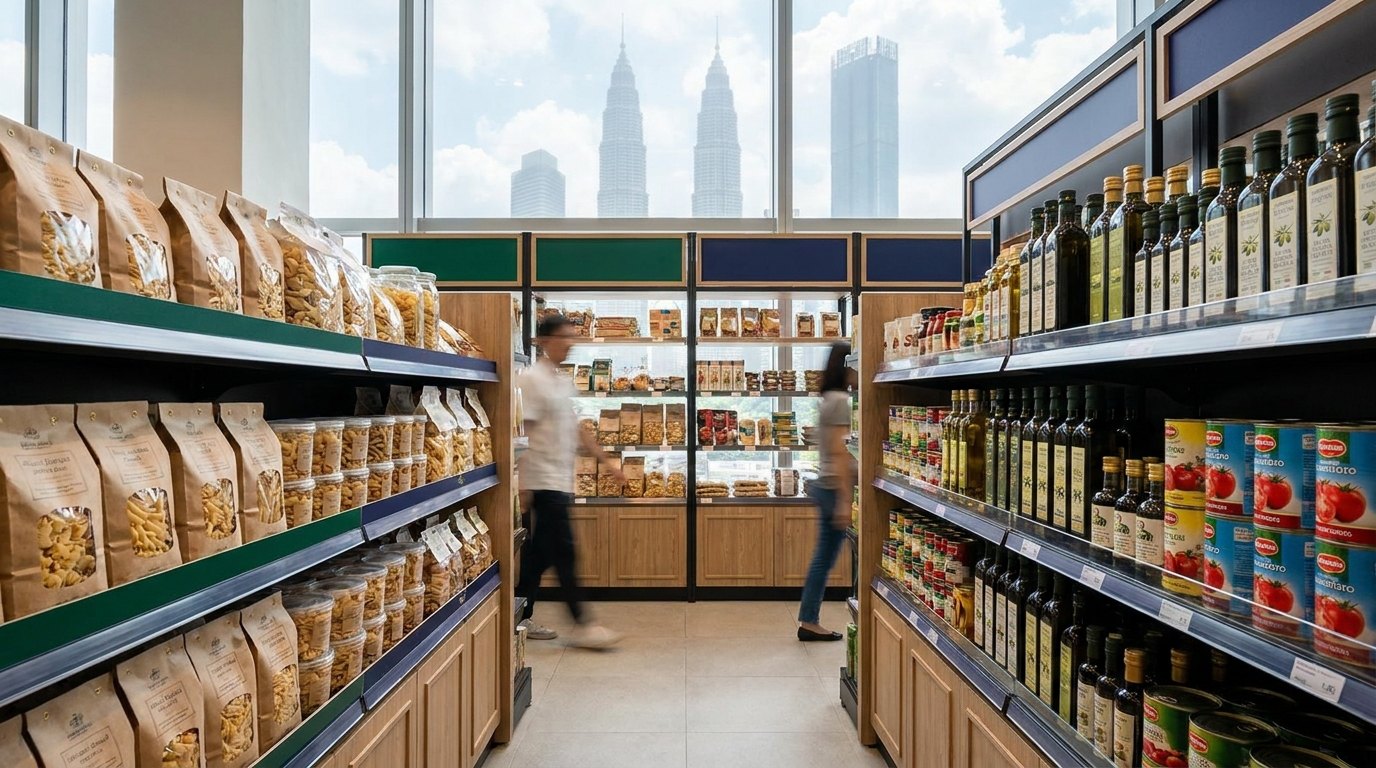
Malaysia is a sophisticated market, with a growing middle class and a heightened focus on the quality of imported food products. Pasta, olive oil, cheeses, tinned tomatoes, baked goods and confectionery are categories in which Made in Italy enjoys an established reputation. With the correct Halal certification, these categories can gain access to Malaysian large-scale retail, the hospitality sector, and e-commerce channels that handle significant volumes in Malaysia.
It is essential, however, that every ingredient, every processing aid and every stage of production be verified. Halal certification does not concern only the finished product: it covers the recipe, suppliers, production lines and the separation from any non-compliant ingredients.
The Halal certification process with HQC Italia for the Malaysian market involves the following main stages:
A quotation is free of charge and is provided within 24 hours of the request.
When a government announces a transition towards higher standards, foreign companies that comply before regulatory deadlines gain a real competitive advantage. Those who wait for the new Malaysian rules to come into force before initiating certification risk finding themselves excluded from the market at precisely the moment when demand is growing.
The news reported by HalalFocus is both a warning sign and an opportunity. Malaysia wants quality Halal products that are certified and traceable. Italian companies have the right products: what is often missing is simply the appropriate certification.
Source: HalalFocus – Malaysia must move beyond Halal certification to global exports
Tell us about your product and your target markets: the quote is free and arrives within 24 hours.