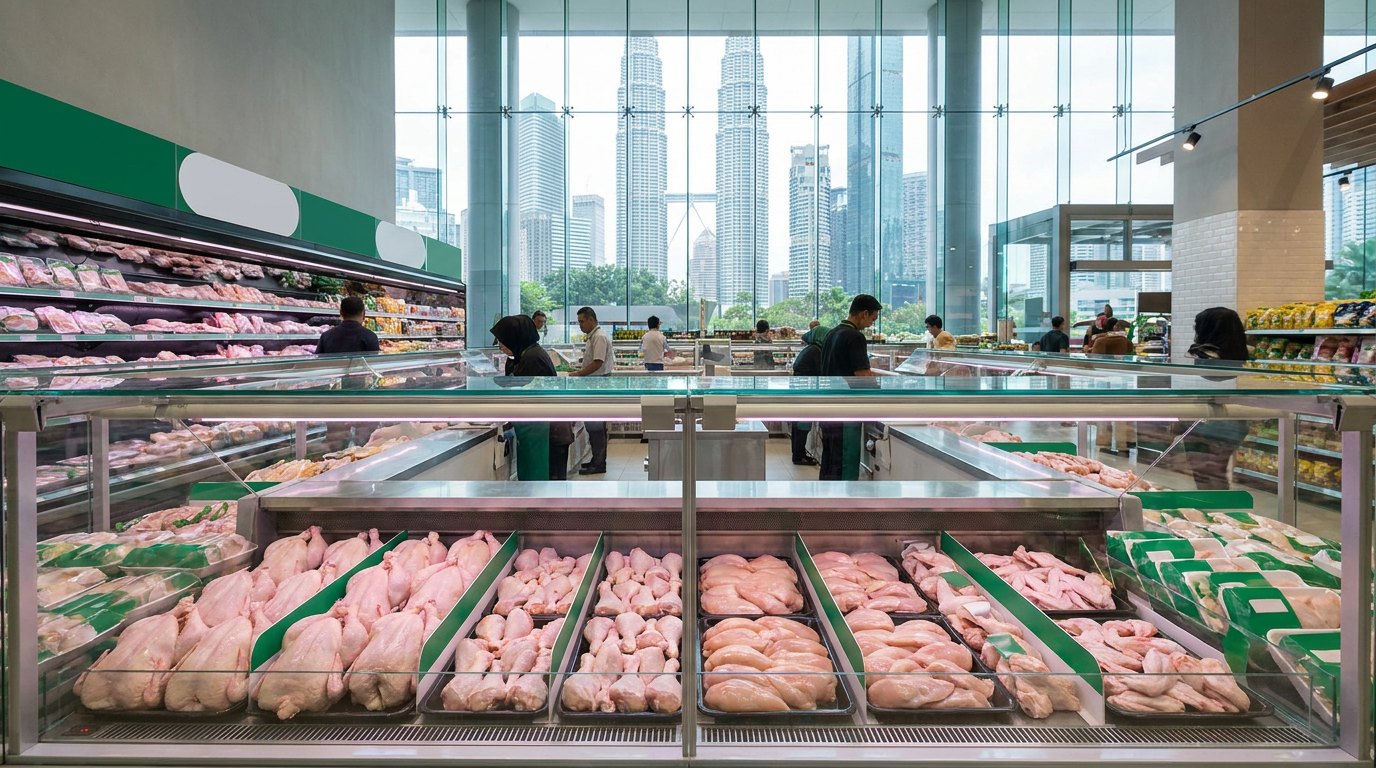
Kuala Lumpur is considering new rules that will allow consumers to verify in real time the Halal status and origin of chicken on sale in the market. For an Italian company exporting poultry to Malaysia, this means that supply-chain transparency becomes a market-access requirement, not a mere formality. Here is what changes in practice and how to prepare.
Malaysia is considering the introduction of new rules that would allow consumers to verify directly the Halal certification status and origin of chicken purchased at a market or supermarket. The stated aim is to strengthen supply-chain transparency, improve controls, and safeguard consumer confidence in Halal products. This was reported by HalalFocus on 17 November 2026.
This is not an isolated proposal. It fits into a trend that Malaysia has consistently followed for years: the country, through JAKIM (the government Halal certification body), already operates one of the most rigorous accreditation systems in the world. A potential requirement for traceability at the point of sale would represent a further step towards a fully verifiable supply chain, from slaughter to shelf.
Malaysia is one of the principal poultry import markets in South-East Asia. For an Italian company that exports or intends to export chicken, turkey, or other poultry to Malaysia, the implications of this regulatory proposal are concrete and immediate.
The key point is not simply the Halal certificate itself — which is already mandatory to access the Malaysian market — but the ability to demonstrate, at every stage of the supply chain, that the product meets Halal requirements: from slaughter, to processing, to transport, through to arrival at the point of sale. If the proposed legislation is adopted, the Malaysian importer will need to be able to link every purchased batch to a verifiable Halal certificate. This obligation falls upstream, that is, on the exporter.
Halal traceability in the poultry sector is not limited to slaughter according to Islamic rite. It encompasses a series of controls covering the entire production chain:
Should Malaysia introduce digital verification for the end consumer, every link in this chain will need to be not only compliant but documented in a way that is readable by a centralised system or a QR code on the product.
To export Halal poultry to Malaysia, the Halal certificate must be issued by a body recognised by JAKIM. HQC Italia is among the foreign bodies recognised by JAKIM. This means that a certificate issued by HQC is accepted by the Malaysian authorities as valid for import purposes.
The certification process for an Italian poultry company involves verification of the slaughterhouse (including compliance with ritual slaughter requirements), an audit of processing and packaging operations, assessment of supply-chain documentation, and the issuance of the certificate. Only after the certificate has been issued may the product be lawfully placed on the market as Halal in Malaysia.
Even though the Malaysian legislation on chicken traceability is not yet in force, the direction is clear. Companies that enter the Malaysian market with a supply chain that is already documented and traceable will hold a competitive advantage when the new rules come into effect. Those who wait for a formal obligation risk having to reorganise processes and documentation under time pressure, with the risk of supply disruptions.
This is not the first time Malaysia has anticipated regulatory trends that subsequently spread to other Islamic markets. Indonesia, for example, followed a similar path with the Halal obligation introduced progressively by product category. Those who were ready gained market positions; those who waited were left playing catch-up.
An Italian company that exports or wishes to export chicken to Malaysia should verify its current position with respect to the following points:
The certification process with HQC Italia begins with a free quotation available within 24 hours of the request. This is the first step in establishing whether your supply chain is already compliant or what adjustments are required before entering the Malaysian market.
HalalFocus, «Consumers in Malaysia may soon be able to check chicken's Halal status under proposed new rules», 17 November 2026 — Read the original article.
Tell us about your product and your target markets: the quote is free and arrives within 24 hours.