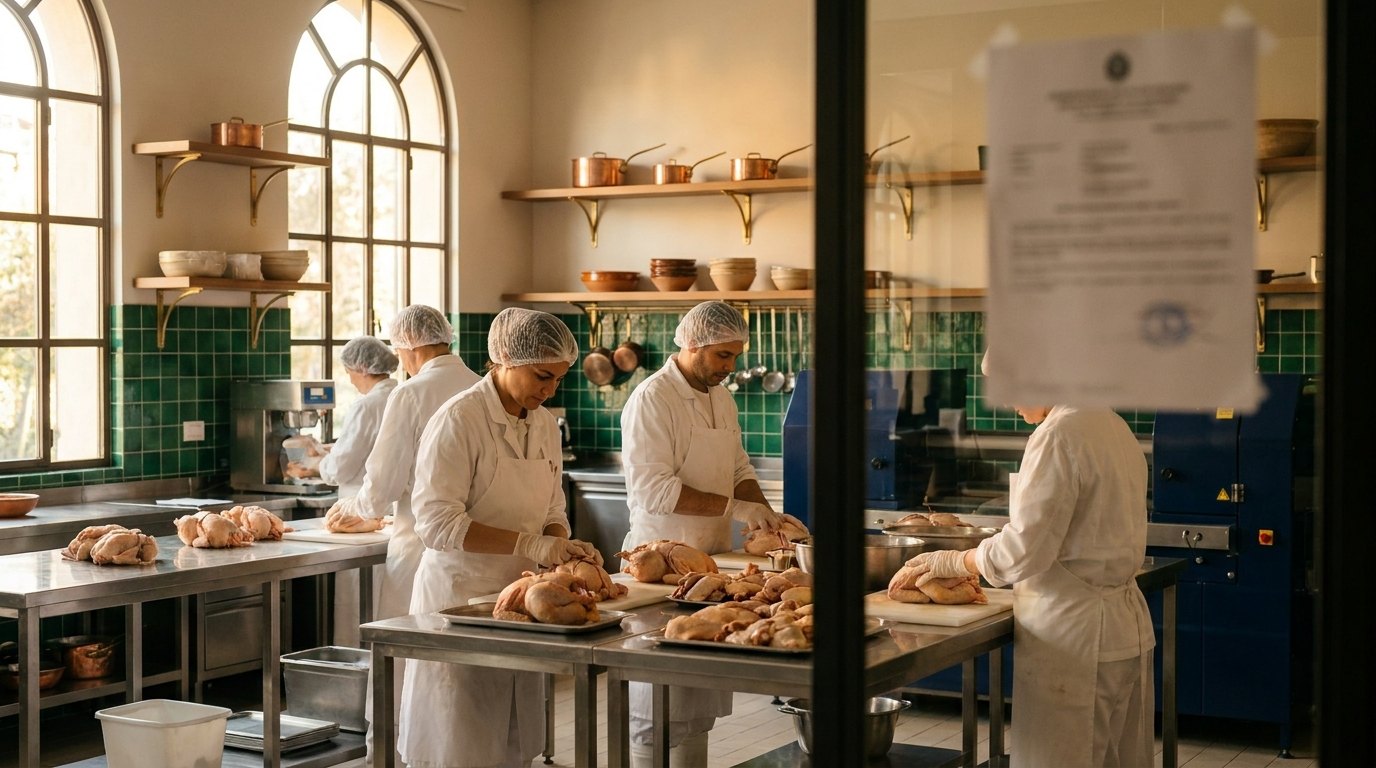
Controversy over religious slaughter in France and the new regulations of 2011-2012 shifted part of the Halal supply chain to Poland. A concrete geopolitical lesson: Islamic markets reward those who guarantee continuity, compliance and recognised certification. Italian food companies can benefit from it.
An analysis published by AhlulBayt News Agency and picked up by HalalFocus reconstructs a textbook case for anyone wanting to export to Islamic markets: the heated political controversy over religious slaughter in France in 2011-2012, combined with new regulations introduced at that time, pushed part of the Halal supply chain outside French borders. Poland was able to seize the opportunity, significantly strengthening its position in the European Halal poultry market.
This is not a historical curiosity. It is a mechanism that keeps repeating itself: when a country that is hesitant or unstable on the regulatory front loses the trust of Islamic buyers, a more reliable competitor takes its place. And that place is not easily given back.
Buyers in Islamic countries — from large retail chains to the import authorities of Saudi Arabia, the Emirates, Malaysia and Indonesia — are not just buying a product. They are buying a guarantee of continuity and compliance. If the political or regulatory context of an exporting country calls into question the legitimacy of Halal slaughter or creates uncertainty about the integrity of the supply chain, importers change supplier. The switch can be quick; the return, very slow.
This is why Halal certification issued by an internationally recognised body is not a bureaucratic detail: it is documentary proof that the company meets stable requirements, verified by a third party and accepted in destination markets. It is exactly what a buyer asks for before listing an Italian product.
Italy has not experienced the same political turbulence as France over religious slaughter. This is a concrete competitive advantage, but only if it is capitalised on. An Italian food company producing meat, cured meats, poultry products, cheeses or any other food suitable for Islamic markets today has an open window that should not be taken for granted.
Poland has shown that someone else's regulatory instability is enough to win lasting market share. In the same way, an Italian company that gets certified today, builds commercial relationships with Islamic importers and covers the main reference markets gains a structural advantage over European competitors who will arrive later.
The France-Poland case suggests a few priority actions for those exporting, or wanting to export, to Islamic markets:
One aspect that often escapes companies approaching Halal certification for the first time is the difference between a generic certificate and a recognised certificate. A body formally recognised by the authorities of importing countries offers a guarantee that a professional buyer can verify independently. This is the kind of certification that really opens the doors to the large Islamic retail chains, public procurement in the Gulf countries and import requirements in regulated markets such as Malaysia and Indonesia.
The history of the European poultry market teaches that opportunities in Islamic markets are built before other people's crises emerge, not after. Italian food companies that choose to get certified today by an internationally recognised body are doing exactly that.
Source: HalalFocus – France Polarized Halal; Poland It Into an Economic Opportunity, September 2026.
Tell us about your product and your target markets: the quote is free and arrives within 24 hours.