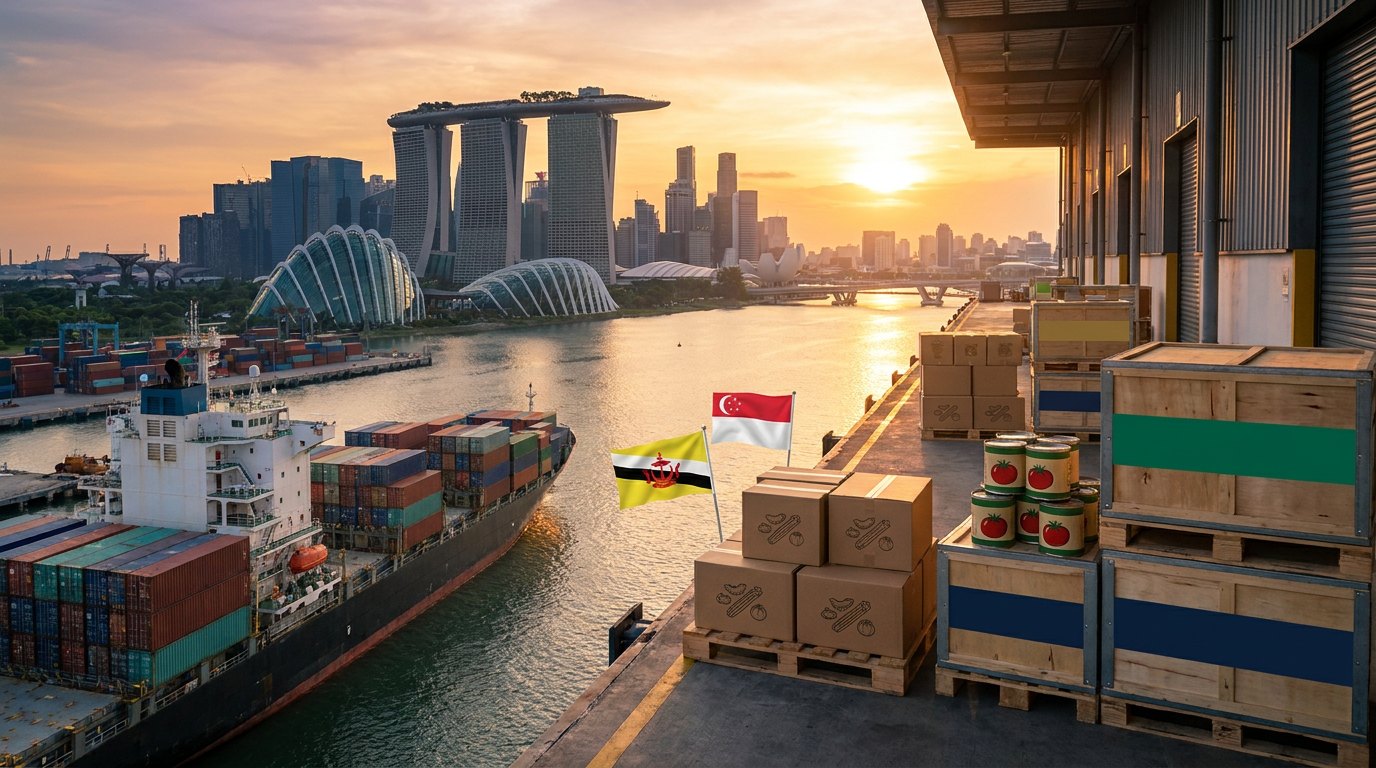
Singapore and Brunei have signed a memorandum of understanding for the mutual recognition of Halal certificates. For an Italian company already certified by HQC Italia, which is recognised in both countries, a smoother trade corridor is opening up in South-East Asia. Here is what it means in practice and how to prepare.
On 14 October 2026, Singapore and Brunei signed a memorandum of understanding (MOU) for the mutual recognition of their respective Halal certificates and marks. The stated objective is twofold: to simplify trade in Halal products between the two countries and to eliminate duplicated certification processes, while preserving the integrity of standards. This was reported by HalalFocus.
In practical terms, a product already Halal-certified to the standards of a body recognised by MUIS (Singapore's authority) will be able to move more easily into the Bruneian market too, and vice versa. It is a step that reduces bureaucratic barriers along one of the most active trade routes in South-East Asia.
At first sight, a bilateral agreement between Singapore and Brunei seems far removed from the interests of an Italian food producer. In reality, it changes the equation concretely for those who export, or intend to export, to that region.
Singapore has for decades been one of South-East Asia's main distribution hubs: many Italian products enter the region through its warehouses and logistics platforms. Brunei, although it has a smaller population, is a market with high per-capita income and very strong Halal awareness, being a Muslim-majority state.
An Italian company obtaining Halal certification recognised by MUIS (Singapore) now finds itself in a more favourable position for access to the Bruneian market too, because the MOU reduces the documentary redundancies that until now slowed down or complicated selling in both countries in parallel.
HQC Italia is recognised by MUIS, Singapore's Halal authority. This means that Italian companies already certified by HQC start from a position of advantage: their certificate is already accepted on the Singapore side of the agreement. With the MOU in force, the same certification gains greater weight with a view to distribution to Brunei as well.
For those not yet certified, the agreement is a signal worth reading carefully: South-East Asia is organising itself into an increasingly integrated system of cross-recognitions. Every MOU signed reduces the cost of accessing several markets for those who start with solid certification, and increases it for those who stay out.
The Singapore-Brunei agreement is not an isolated case. In recent years, international Halal trade has progressively been structured around networks of mutual recognition between bodies and national authorities. Malaysia and Indonesia, for example, have already launched a bilateral Halal council. Vietnam was recently recognised by Malaysia's JAKIM.
This means the Halal certification landscape is no longer a collection of separate markets, each with its own watertight rules. It is becoming a network in which the entry points multiply — but only for those already positioned with a body accredited at the key nodes of that network.
For an Italian company, choosing the wrong certification body — perhaps one recognised in a single country — means automatically missing out on the multiplier effect of every new MOU signed. Choosing a body such as HQC Italia, recognised in more than 50 Islamic countries and accredited by authorities such as MUIS, JAKIM, MUI and BPJPH, means instead that every new bilateral agreement signed by one of those countries adds value to the certification the company already holds.
The agreement between Singapore and Brunei is a concrete sign of how Halal trade in South-East Asia is consolidating into an integrated system. For an Italian food company, this is not exotic news: it is an opportunity to access high-income markets with strong Halal awareness, with less bureaucratic friction than in the past — provided you already have the right certification. HQC Italia provides a free quote within 24 hours.
Source: HalalFocus – Singapore, Brunei sign agreement to recognise each other's Halal certificates (14 October 2026).
Tell us about your product and your target markets: the quote is free and arrives within 24 hours.