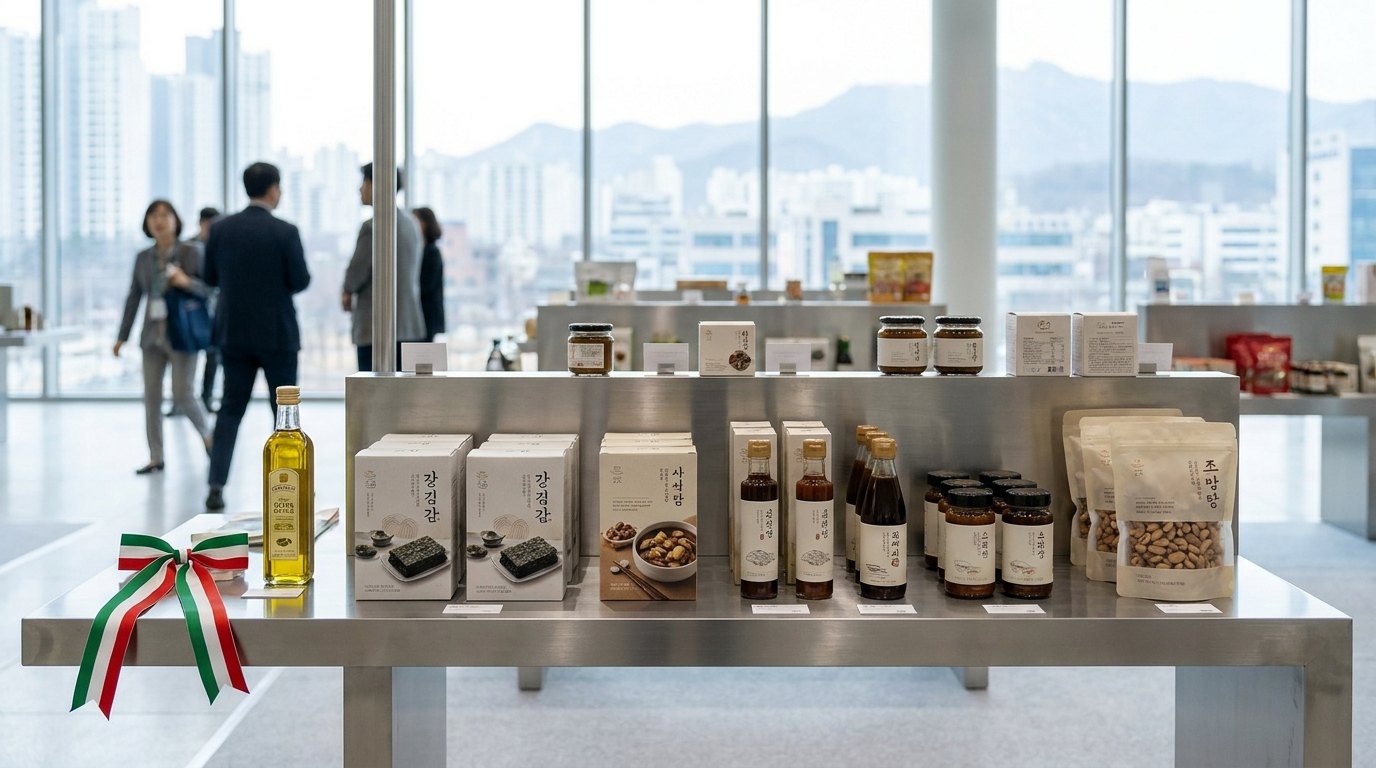
On 16 October 2026 five South Korean institutions signed an agreement to coordinate and accelerate Halal exports to Islamic markets. The signal is clear: the competition is getting organised, and an Italian agri-food company needs to respond with an equally structured strategy.
On 16 October 2026, five South Korean institutions signed a Memorandum of Understanding to jointly promote Halal exports by Korean companies to Muslim-majority markets. The agreement, reported by The Halal Times, brings together certification support, market access, connections with international buyers and coordination between trade promotion agencies within a single operational framework.
This is not foreign-policy news. It is a direct market signal: a country that until a few years ago was considered marginal in the Halal economy is building a systematic infrastructure to compete. And it is doing so just days after Indonesia, the world's largest Halal market by population, moved some mandatory certification deadlines to 2028, opening a window that those who are ready can exploit.
South Korea does not export pasta or olive oil. But it does export processed foods, sauces, snacks, ingredients, cosmetics and pharmaceuticals to the same markets an Italian agri-food company wants to reach: the Gulf, Malaysia, Indonesia, Singapore. The point is not product overlap, but competitive logic.
When a country brings five agencies together in an MOU dedicated to Halal exports, it is telling its operators that Halal certification is a strategic priority, not a bureaucratic formality. It is building a support chain that cuts lead times, lowers costs and increases the credibility of Korean products in the eyes of Islamic importers.
An Italian company that has not yet certified its products, or that works with a body not recognised in its destination markets, risks being at a disadvantage not only against European competitors but also against increasingly well-organised Asian players.
Halal certification is not the same everywhere. Each destination market has its own reference authorities and its own lists of accredited bodies. A certificate issued by a body that is not recognised in the importing country has no customs or commercial value: the product may be held at the border or excluded from local organised retail.
For an Italian company that wants to export to Saudi Arabia, the reference is SASO and SFDA. For the Emirates and the Gulf, GAC and EIAC. For Malaysia, JAKIM. For Indonesia, BPJPH. For Singapore, MUIS. For Thailand, CICOT. There is no single universal certificate: there are networks of mutual recognition, and the quality of a certification body is measured precisely by how many of these recognitions it holds.
This is where the game is played: not on the price of the certificate, but on its usability in real markets.
The Korean move is not an isolated one. In recent months, several producer countries have accelerated the structuring of their Halal offering: Brazil through its large meat players, Malaysia by strengthening SMEs for export, and now South Korea with five-agency institutional coordination. Italy has on its side the reputation of Made in Italy, the quality of its raw materials and a globally recognised food tradition. But reputation alone does not open the customs gates of Islamic markets: you need a valid certificate, issued by a recognised body and backed by complete, up-to-date documentation.
Those who start now still have an advantage: the window opened by Indonesia's postponement to 2028, Gulf markets reorganising after the regional conflict, and global demand for Halal products that keeps growing. Those who wait risk chasing competitors who have already established their presence.
Source: The Halal Times – Korea Halal Export MOU Unites Five Agencies Behind Exporters
Tell us about your product and target markets: the quote is free and you will receive it within 24 hours.