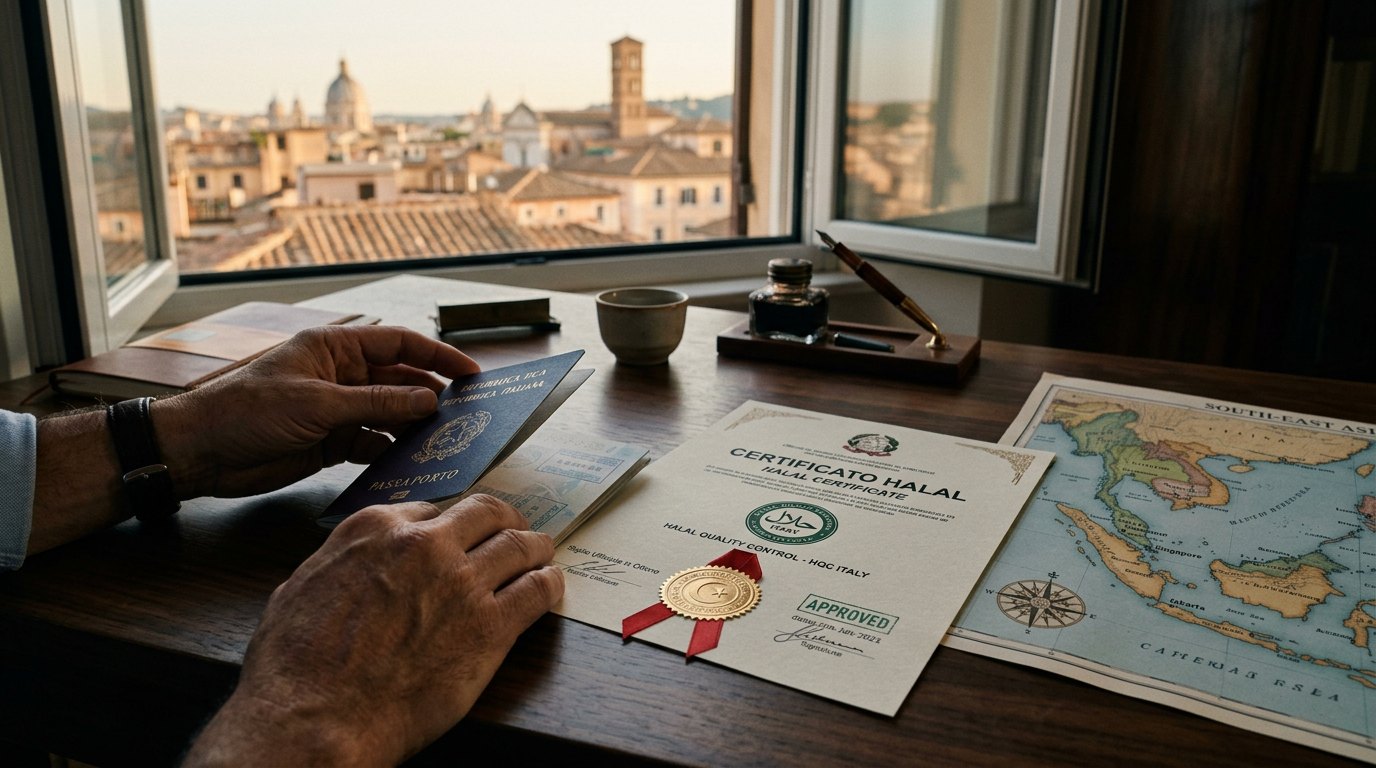
BPJPH, the Indonesian Halal Product Assurance Agency, has approved the extension of HQC Italia's accreditation to two new scopes: cosmetics and pharmaceuticals. For Italian companies in these sectors it means one concrete thing: the certification process for the Indonesian market can be started and managed in Italy, in Italian, with a body recognised directly by the authority in Jakarta.
In Indonesia, Halal certification is not a commercial choice but a legal requirement, administered by the State through BPJPH (Badan Penyelenggara Jaminan Produk Halal). A foreign company does not certify directly with the agency: it obtains its certificate from a foreign body that BPJPH has recognised and then registers it for the Indonesian market. Recognition is not generic: it applies to specific scopes. A body may be recognised for food but not for cosmetics, in which case its certificate for a lipstick or a cream has no effect in Indonesia.
That is why this extension matters. Until now, many Italian cosmetics and pharmaceutical companies holding a Halal certificate found themselves having to redo or supplement it through foreign bodies to enter Indonesia. From now on the whole process, audit included, can be handled from the Rome office.
Indonesia enforces the Halal requirement in phases. After food and beverages, from 17 October 2026 the obligation extends to cosmetic products and other non-food categories. From that date, a product arriving at customs without a BPJPH-recognised certificate does not get in. For pharmaceuticals the timetable is broken down by product type and must be checked case by case, but the direction is the same.
With over 280 million inhabitants and a growing middle class, Indonesia is the world's largest Halal market for cosmetics as well. "Made in Italy" personal care enjoys an established reputation in South-East Asia: a recognised certification is what turns that reputation into actual shelf access.
In the cosmetics sector the critical points are recurrent and almost always the same. We have summarised them in the HQC guideline "Halal Control Points – Cosmetics Sector", available on the Documents & Guidelines page. In brief:
| Area | What is verified |
|---|---|
| Animal-derived raw materials | Collagen, glycerine, stearic acid, fatty alcohols, enzymes: traceability to the source is required and, for animal derivatives, Halal slaughter. |
| Alcohol and fragrance carriers | Alcohol cannot be used unless assessed and permitted under the applicable standards; perfumes are the highest-risk category. |
| Emulsifiers, surfactants, pigments | Even in small quantities they must be Halal certified or supported by sufficient documentation. |
| Multi-purpose facilities | Line separation, cleaning and cross-contamination prevention must be demonstrable, not merely declared. |
| Growth media | For microbial-origin ingredients, growth media must be free from najis or haram substances. |
For pharmaceutical products the Halal question mainly concerns excipients, capsules (gelatine), solvents and fermentation processes. Risk classification follows the HQC Risk Classification table, also available for download on our website, and the certification process adapts to the complexity of the product. Here too the advantage of direct accreditation is tangible: a single contact in Italy, a single audit, a certificate that BPJPH recognises.
A preliminary assessment is free and takes little time. Italian enquiries are handled personally.
Read also: exporting to Indonesia, what the BPJPH requirement means
← Back to the blog