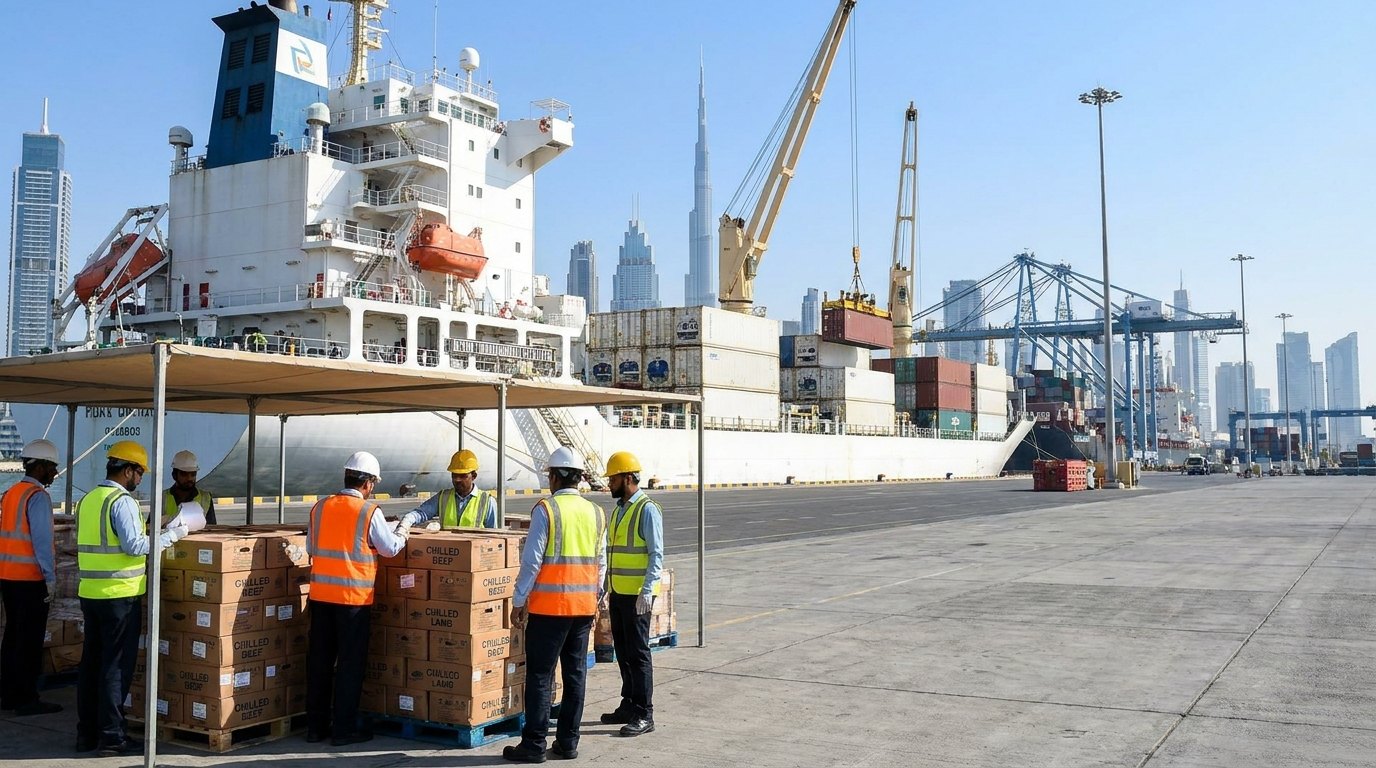
The United Arab Emirates has withdrawn recognition from a New Zealand halal certification body, blocking meat exports worth approximately NZD 60 million per year. The case demonstrates that gaining access to a market is not enough: a valid certification issued by a body recognised by the importing country's authorities must be maintained over time. Here is what Italian companies need to know to avoid the same outcome.
The government of the United Arab Emirates has revoked the registration of the New Zealand Islamic Development Trust (NZIDT) as an authorised halal certification body. The consequences are immediate and severe: New Zealand meat products certified by that body can no longer be shipped to the UAE. A market worth approximately NZD 60 million per year closed following a single administrative decision, leaving exporters scrambling to find alternative bodies recognised by the UAE authorities.
The story, reported by HalalFocus on 26 October 2026, does not concern a production error, food fraud, or a food-safety issue. It concerns exclusively the status of the certification body with the authorities of the importing country. This is an important distinction, because many companies tend to treat halal certification as a document to be obtained once and then forgotten. This case demonstrates that this is not the case.
Every Islamic country that imports halal products maintains its own register of authorised foreign certification bodies. It is not enough for a body to be accredited or recognised internationally in a generic sense: it must be specifically approved by the competent authority of the destination country. In the United Arab Emirates this function is carried out by GAC (Emirates Authority for Standardization and Metrology) and EIAC (Emirates International Accreditation Centre). In Saudi Arabia the relevant bodies are SASO and SFDA. In Malaysia it is JAKIM, in Indonesia BPJPH, in Singapore MUIS, and in Thailand CICOT.
If an Italian company obtains halal certification from a body that does not appear on the approved list of the country to which it wishes to export, its products may be held at customs or rejected — exactly as happened to New Zealand exporters. The certificate itself is not sufficient: what matters is who issued it and whether that body is recognised by the authority of the destination market.
The New Zealand case highlights two distinct risks that directly affect Italian agri-food companies.
The halal certification process for export involves certain preliminary checks that no company should skip:
HQC Italia holds direct recognition from the authorities of the principal halal import markets: GAC and EIAC for the United Arab Emirates and the Gulf, SASO and SFDA for Saudi Arabia, JAKIM for Malaysia, MUI and BPJPH for Indonesia, MUIS for Singapore, and CICOT for Thailand. This means that certificates issued by HQC are accepted at the customs of these countries without the need for additional validation. The ISO/IEC 17065 accreditation — held by HQC as the first halal body in Europe since 1983 — further guarantees that the certification procedures meet internationally verifiable standards audited by third parties.
An Italian company that obtains certification from a body not present on these lists runs exactly the same risk as New Zealand exporters: a sudden block that has nothing to do with product quality, but everything to do with the status of the certification body.
If your company already exports to Islamic markets, check that the body which issued your halal certificate still appears on the official lists of the destination countries. If you are considering starting, the first step is to request a free quote: HQC Italia responds within 24 hours and the certification process is defined on the basis of the markets you intend to reach and the product categories involved.
Source: HalalFocus, «Halal certification issue halts NZ meat exports to UAE», 26 October 2026 — halalfocus.com
Tell us about your product and your target markets: the quote is free and arrives within 24 hours.